
Area of Physical Organic Chemistry Course of Materials
Chemistry, Division of Applied Chemistry,
Graduate School of
Engineering,The University of Osaka.
-
Functional Organic Materials Based on the Curved π-Molecule Sumanene
-
Precision Design of Metal Nanoparticle Catalysts for Sustainable Chemistry
-
Development of Dynamic Organic Crystals
-
Interfacial Nanoscience Based on Electrochemistry and Laser Ablation
-
Functional Organic Materials Based on the Curved π-Molecule Sumanene
![]() read more
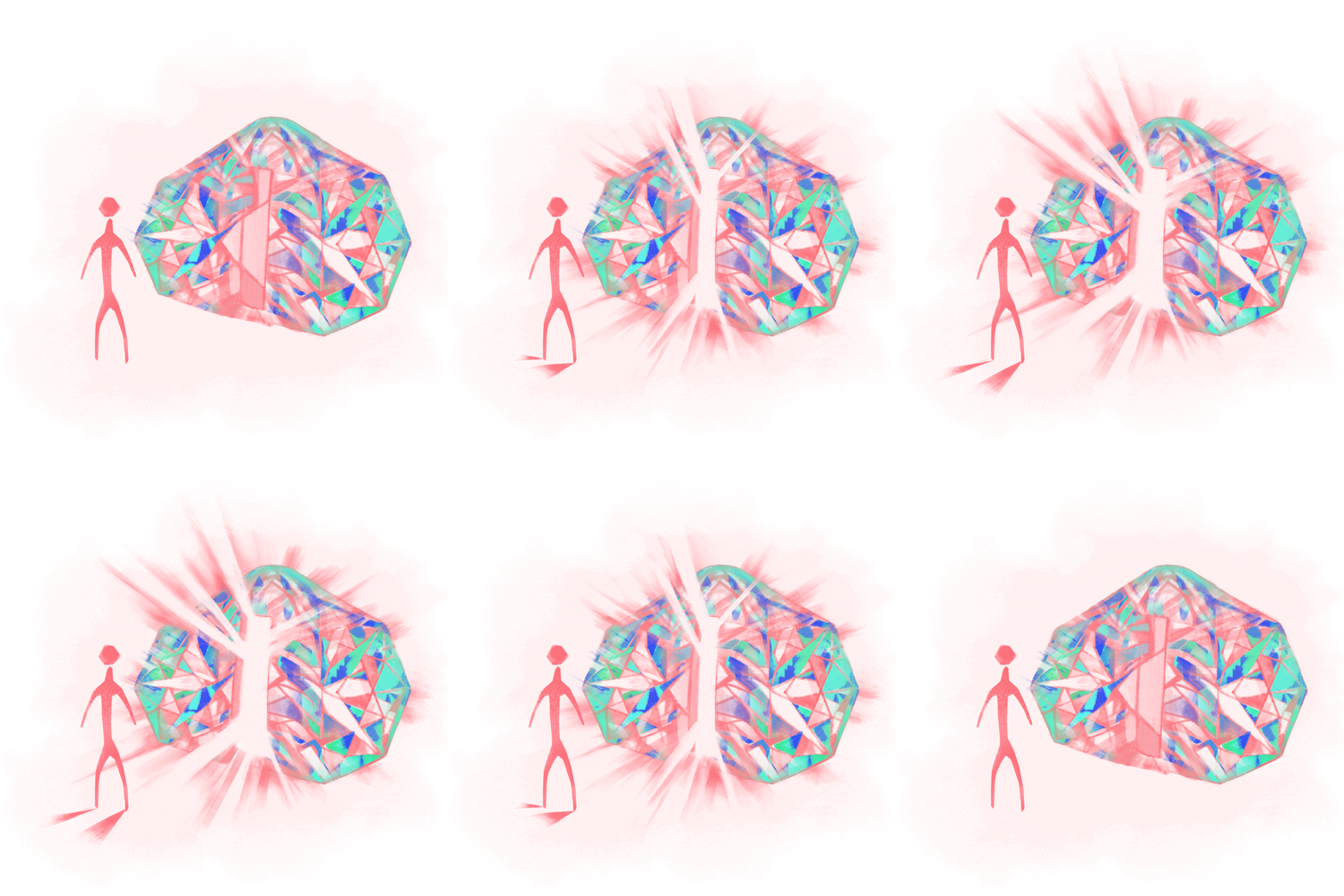
read moreThe Sakurai Laboratory explores new functional organic materials based on sumanene, a C3v-symmetric, bowl-shaped, π-conjugated molecule that represents a partial structure of fullerene. Unlike conventional aromatic molecules with planar π-systems, sumanene is characterized by its bowl-shaped, curved π-surface. This molecular curvature gives rise to distinctive properties not found in planar π-molecules, including a molecular dipole moment, bowl inversion, and concave–convex interactions, leading to unique electronic states, molecular dynamics, and self-assembly behavior in molecular aggregates and crystals.

Starting from the synthetic chemistry of sumanene itself, our research has expanded to the molecular design and synthesis of diverse derivatives, the construction of molecular assemblies and crystals, and ultimately the development of functional materials. A fundamental question underlying our research is: “What changes when an aromatic molecule becomes curved?” We seek to understand how molecular curvature affects electronic structures, molecular dynamics, and intermolecular interactions, and to establish curvature itself as a molecular design parameter for generating new functions. Our research now encompasses organic electronic materials, molecular recognition, porous materials, dielectric molecular crystals, and luminescent materials.

Recently, we have demonstrated anisotropic dielectric responses in fluorinated sumanene derivatives by exploiting bowl orientation and molecular motion within the crystal lattice. We have also shown that solvent-controlled crystallization can produce different crystalline phases with distinct dielectric properties from the same molecule. These studies seek to connect molecular “shape” and “motion” directly with functions emerging in the crystalline state.

We are also developing porous frameworks, including metal–organic frameworks (MOFs), hydrogen-bonded organic frameworks (HOFs), and covalent organic frameworks (COFs), incorporating sumanene-based building blocks. Introducing curved π-units, rather than conventional planar building blocks, into porous materials creates distinctive pore structures and local chemical environments that can be exploited for molecular adsorption, including ammonia and CO₂, as well as for controlling electronic properties. By employing curved π-molecules, which occupy the structural space between two-dimensional planar systems and three-dimensional architectures, as fundamental building blocks, we aim to open a new area of materials science that we may describe as “2.5-dimensional materials science.”

We are further interested in the strong electron-accepting character of trioxosumanene, an oxidized form of sumanene. Recently, donor–acceptor systems employing trioxosumanene derivatives as acceptors have achieved highly efficient near-infrared (NIR) emission and characteristic charge-transfer excited states. Through these studies, we aim to reveal how molecular curvature influences electronic structures, molecular assembly, molecular dynamics, and photophysical properties, ultimately establishing a new organic materials chemistry based on functions that emerge specifically from molecular curvature.


-
Precision Design of Metal Nanoparticle Catalysts for Sustainable Chemistry
![]() read more
read moreMetal nanoparticles possess electronic structures distinct from those of bulk metals and exceptionally high surface-to-volume ratios, giving rise to unique catalytic reactivity. Our laboratory began exploring the application of gold nanoparticles to organic synthesis at a relatively early stage in the development of gold nanoparticle catalysis and has reported pioneering studies demonstrating that gold nanoparticles can serve not merely as oxidation catalysts but as versatile catalysts for synthetic organic reactions.

Our research subsequently expanded from monometallic nanoparticles to alloy nanoparticles, aiming to create new catalytic functions by combining different metals at the nanoscale. One representative achievement was the use of Au/Pd alloy nanoparticles to activate otherwise unreactive carbon–chlorine (C–Cl) bonds at low temperatures and to utilize them in organic synthesis. This work demonstrated that controlling not only nanoparticle size but also alloy composition and electronic interactions between different metals can enable transformations that are difficult to achieve using individual metals alone.

Building on these studies, we now regard the “matrix” and “interface” surrounding a nanoparticle as important design parameters alongside particle size, alloying, and surface electronic structure. Catalytic activity is determined not only by the intrinsic properties of the metal nanoparticle but also by its surrounding environment, which controls its immobilization and stabilization. We therefore seek to develop new nanocatalysts whose activity, selectivity, and durability can be controlled through interactions between nanoparticles and their supporting matrices.

In recent years, we have focused particularly on biopolymers such as cellulose, chitosan, and gelatin as matrices to support and stabilize metal nanoparticles. For example, cellulose nanofiber-supported gold nanoparticles exhibit excellent catalytic stability and recyclability. By extending our research from the use of gold nanoparticles in organic synthesis to the control of reactivity through alloying and, more recently, through matrix and interface engineering, we aim to develop next-generation nanocatalysts that combine high activity and selectivity with environmental sustainability.
-
Development of Dynamic Organic Crystals
![]() read more
read moreWe investigate functional molecular crystals based on molecular design and crystal engineering. The properties of molecular crystals are governed by diverse factors, including molecular flexibility, host–guest interactions, and molecular packing. Our goal is to understand the relationship between molecular assembly and crystal functions, such as luminescence, conductivity, and stimuli responsiveness, and to apply these principles to the development of new sensing technologies and functional materials.

In particular, we focus on small organic molecules, including indanedione dimers with characteristic butterfly-shaped structures. The host crystals formed by these molecules can reversibly incorporate other molecules as guests into spaces within their crystal frameworks, inducing dramatic structural transformations and changes in material properties. We also investigate systems in which the type and amount of incorporated guest molecules alter the emission color, visible color, electronic state, or conductivity of the crystals.

Host–guest molecular recognition is one of our key approaches to controlling material functions because it can induce substantial changes in properties without requiring specialized precursors or complicated processing. By controlling guest selectivity, uptake, and spatial arrangement within crystals, we seek to develop new luminescent materials, sensing devices, and responsive materials. We are also investigating how the properties of guest molecules affect subtle structural features of host frameworks, with the ultimate goal of discovering new functions through precise structural control.


-
Interfacial Nanoscience Based on Electrochemistry and Laser Ablation
![]() read more
read moreWe are developing “interfacial nanoscience” based on electrochemistry and laser ablation.
Electrochemical reactions are governed by a variety of phenomena occurring at electrode/solution interfaces, including electron transfer, mass transport, adsorption, and electric double-layer formation. We seek to understand the relationship between these interfacial phenomena and electrochemical responses and to translate this understanding into new sensing technologies and functional materials.
More recently, we have focused on molecular adsorption and solvent structures at nanoparticle/liquid interfaces, exploring how interface control can be used to optimize nanoparticle functions.

In particular, we are interested in how electrode materials, nanoparticles, and interfacial structures influence electrochemical responses, with a focus on understanding interfacial reactions under complex conditions, including biologically relevant environments and heterogeneous reaction fields.

Our laboratory also investigates the synthesis of metal nanoparticles by pulsed laser ablation in liquids (PLAL) using microchip lasers. PLAL is a clean nanoparticle production method that does not require chemical reducing agents or precursors and has attracted increasing attention as an environmentally friendly process. By controlling cavitation bubble formation, particle growth, interfacial reactions, and solvent effects, we aim to develop new nanoparticle materials and catalytic systems.